
“I write because I don’t know what I think until I read what I say.” Flannery O’Connor
In last week’s blog post I wrote, “for me, journaling is a gateway within.” Like Miss O’Connor, I often don’t know exactly what it is that I think, or even how I feel, until I begin the process of setting pen to paper.
I have kept a journal for as long as I can remember. In the beginning, my entries mostly detailed the events of my days and were devoid of much emotion. March 22, 2001 reads, “Dear diary, today I watched Matilda. Me and Jimi played school. Then we went to Animal Land. I got a new baby rat. I named her Zorro.” Over the years though, the entries became more complex, more descriptive of not just my outer world, but my inner world as well.
Journaling has become a necessity for my overall wellbeing. Much like I notice the effects of not getting enough sleep, or not drinking enough water, I notice when I haven’t been journaling. And there is a body of research to support this. A New York Times article reads, “Journaling has become a hallmark of the self-care movement…scientific studies have shown it to be essentially a panacea for modern times.” A panacea – a remedy for all difficulties and disease.
Journaling allows me to sort through the mess in my mind. It is a stress reliever, a mood booster, and a tool for self-discovery. Other benefits that have been found to be associated with journaling include, “better sleep, more self-confidence, a boost in mindfulness, and memory and communication skills” [New York Times]. And why? How can one simple practice have such profound effects? One theory is that “journaling allows for the labeling of emotions and acknowledging of traumatic events – both natural outcomes of journaling have positive effects on people” [New York Times].
Even when armed with the knowledge of these benefits, many people struggle to begin and maintain a journaling practice. I understand, it can be difficult when so many things are competing for our time and attention. There are days, even weeks, where I don’t journal. But I always miss it and its absence impacts both my mood and state of mind. Which is why I return to the practice again and again.
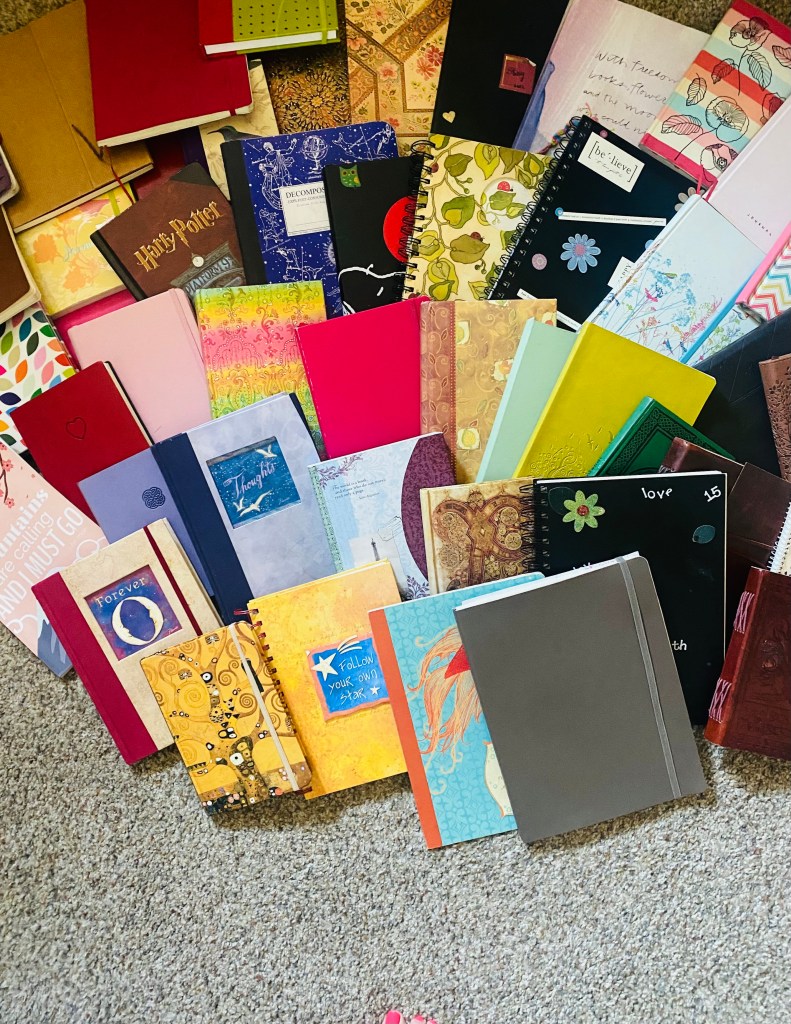
Through the 20+ years that I’ve spent with a journal never far from reach, I’ve come up with a few tips for integrating this practice into your life.
The Journal
One of the most fun parts of journaling in my opinion, is the act of choosing your journal. This is where your personality can really shine through and guide you to a journal that inspires you to spend time with it each day. I have had all types of journals – both soft and hard-back, journals with intricate designs all over the cover and journals in a plain and solid color, journals with lines and journals without. Depending on the season of life that I am in, different journals will speak to me. I encourage you to take some time with this and choose one that speaks to you. Afterall, you will be spending some time together!
Routine & Ritual
I find that journaling in the morning, right when I wake up, works best. This is when I am the most “unfiltered” and the words on the page hold the most truth. For others, the idea of journaling first thing in the morning may have them pulling the sheets back over their head. Choose a time of day that works for you, 5 – 20 minutes where you can sit in uninterrupted quiet with yourself and just write. Establishing a routine around when you write makes it so much easier to return to your journal each day.
Once you have your routine, the next step would be to create a ritual around your time spent journaling. For example, I always drink my coffee while I journal. Other ideas include lighting a candle or playing some soft music, whatever gets you in the mood.
Let It Out
What do you write about in a journal? Anything and everything. This is your time to expel it all! Get that stagnant energy out of your body and onto the page. Brain-dump. Don’t worry about spelling or grammar. Don’t worry about whether or not what you write is coherent or cohesive. Just write. I often start my journal entries off with something like, “Right now I am feeling…” or “Something on my mind right now is…” That is a launching pad and from there the words usually come flooding out. For more ideas just go to the internet, it is full of journal prompts.
Have Fun
Yes, FUN. Let journaling be fun for you. Tailor the practice to fit your needs and energy levels. Journaling is a release, not something to add to your plate and then feel stressed out about.
Journaling has helped me get through some of the most challenging times in my life – navigating recovery from an eating disorder, heart wrenching break-ups, death of loved ones, cancer, chemo, COVID-19, and all of the other stressors life has thrown my way over the last 30 years. Journaling has also allowed me to document some of the most beautiful and memorable moments of my life – trips abroad, graduations, new jobs, loved ones coming safely out of surgery, crushes that bud into full fledged love, finishing chemotherapy, moves to new states, developing friendships, time with family, and so much more.
I am beyond grateful that I have my journals to look back on, beyond grateful for the self discovery that continues to bloom out of a regular journaling practice. And I will reference my journals many more times, as they’re a part of me.
If you already journal then I am sure that all, or at least some, of what I have written here resonates with you. And if you don’t journal, I encourage you to start. Maybe it will be life changing. Maybe it won’t. Either way, you won’t know until you try.
“Fill your paper with the breathings of your heart.” – William Wordsworth
 backtomeblog.com
Thank you so much, I appreciate your encouragement.
LikeLiked by 1 person