The fear of failure can keep myself, and many others from trying new things. Not wanting to feel embarrassed in front of one’s peers, the potential for injury, or even the possibility that pursuing a new venture could result in the loss of all that is familiar, comfortable and protected. Yet it is often through walking straight into the fear that we grow and evolve as humans.
I grappled with such fear for a couple of months as I weighed the options of quitting my job as an educator in order to take a year to travel vs. staying in the security of a steady income and health insurance. When in the deep end of the fear pool, it is easy to convince yourself that it isn’t fear that is holding you back, but instead the rational, logical part of yourself convincing you to stay safe in the shallow waters. I am very fortunate to have a handful of people in my life that will encourage me to take the more “risky” option. The encouragement of even just one trusted soul is often all that we need in order to dive into the unknown and have faith that you will, safely, find your way back to air.
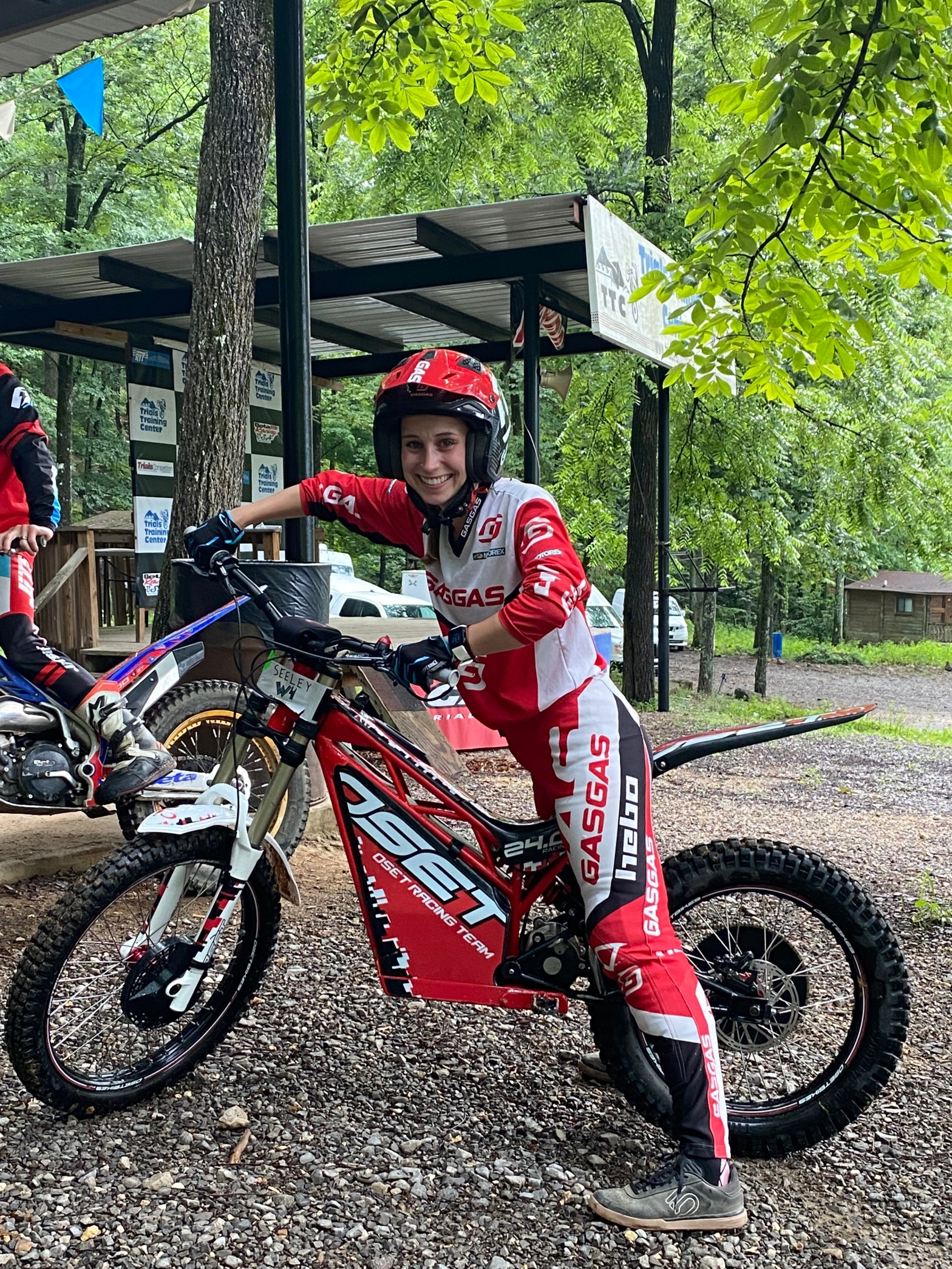
This last weekend was an example of that; a little bit of pressure from the right person and I found myself alone on a trial motorcycle for the first time. I HATE not being proficient at something, which can keep me from crossing over into unchartered territory. I have stealthily, quietly, avoided finding myself alone on a moto-trials bike for the last few years – despite my boyfriend being a professional moto-trials rider. As fate would have it though, the stars aligned in Tennessee and an electric Oset bike was kindly made available for my use. No more avoidance.
“Are you excited?” Daniel questioned as I slinked toward him, decked out in his GasGas practice gear.
“Yes…but also a bit nervous” I replied with a small smile.
Within the first five minutes of being on the bike, I whiskey-throttled several times and managed to narrowly miss going head first into a log. But with time, practice and expert coaching, I began to get the hang of it. By the end of our forty-five minute training session, Daniel declared me ready for my first Trial Competition which would take place in two days. The part of me that thrives off competition, and quite honestly, recognition, agreed.
That is how, after just two hours of time spent practicing maneuvering and rolling over logs, I found myself picking up a scorecard, ready to go head to head with some seven year olds on the four line (the easiest competition line).
“You are riding in the youth nationals? The YOUTH nationals?” a little girl with curly brown hair peered up through her helmet, inquiring of me.
“Yes, but trust me, you don’t have to worry about me”, I assured her with a conspiring smile.
That was made quite clear as she cleaned her first section seamlessly, and I … Well, I didn’t. The name of the game in trials is to make it through a set of obstacles without needing to put a foot down on the course – this is considered a “clean” ride. As the first day progressed and I became more accustomed to how much power to give when weaving between trees or bumping over rocks, I began to find a sense of flow. I even started to have a lot of fun, beginning to see just how addicting trials riding can be. It didn’t matter that at the day’s end I took third out of three, I felt like I’d done well for being so new to the sport and I basked in the praise being offered forth by others. I love praise. I love compliments. The enneagram type 3 in me lives for accomplishments that make those around me look on with pride or admiration.
There is danger in feeding so intensely off of achievement and external validation. When you’re trying something new it is very likely that you’ll fall flat on your face at some point in the learning process. You will not always “achieve” by the standard definition of the word. That is, quite literally what happened to me on day two of the trial.
I started out strong, cleaning my first two sections and thinking to myself,
“I got the hang of this!” But things started to go downhill as I found myself making mistakes over and around obstacles, while simultaneously watching seven year olds perfectly maneuver the same obstacles. The doubt and frustration quickly set in. Tears pricked against my eyes. Daniel could sense something was wrong, but I felt that if I opened my mouth to explain, then the flood gates would surely open. So I pushed on through the sections, my performance getting progressively worse.
When all 12 sections were complete, I quickly rode myself back to the pits to turn in my scorecard. I then proceeded to shut myself into our cabin, where I finally allowed the tears to fall. I was upset that I didn’t ride well, but more than that I was upset that I was upset.
Why was I so easily frustrated by my own performance at something still so new to me? Why was I irritated by young kids beating me? Don’t I have thicker skin than that? The thoughts began to dance.
When I perceive that I have failed at something, the negative thoughts begin to pour in. There’s no filter, all of my insecurities begin to rear their head. I can easily spiral down into the dark depths of my own mind.
Luckily, I have tools that help me crawl back out before I am entirely swallowed by the vortex of self-doubt. Journaling helps. So does talking to a loved one. As I look back on what I wrote immediately following the event, and reflect on my conversation with Daniel, it is apparent that my embarrassment with my performance, as well as with my own emotions, led me to a high level of frustration. The frustration quickly folded into the much larger issue: my own entrenched association between failure and self-worth.
I know I am not alone in this. Many competitive, achievement driven people share in this experience. One set back can lead to a mutiny of self doubt. If unexamined it can result in paralysis, an inability to try new things, or to give up on something too soon for a fear of failure. When examined, however, when analyzed, and processed, it is an opportunity for growth.
The fact that a poor performance following my third hour in a new sport could send me into such a tailspin, indicates that I need to continue to put myself into situations where I very well may “fail”. Where I very well may embarrass myself. For it is through this that I can strengthen the mental muscles that allow me to fail without breaking down.
On Saturday afternoon I was convinced that I NEVER wanted to ride a trials motorbike again. Now I know that I not only want to, but that I NEED to. We all need to put ourselves into situations that we’re resistant to, and we need to do it again and again. That’s the only way to grow. While stagnation can be comfortable, expansion is where life’s brightest hues of color and most profound forms of beauty reside.
 backtomeblog.com
Trials is really hard! It kicks you when you’re down so if you’re able to pick yourself up and try again you are a rock star in my book!
LikeLike
Mimi,
I love your writing. You make me think, feel, hope, reflect, and smile.
Felt like I was reading a best seller book and can’t wait for the next chapter!
Enjoy your journey!
Can’t wait to read more about your adventures!
Sending hugs!
LikeLike
Mimi, this is a great piece and some very honest self-reflection. I would say writing all this and putting yourself out there this way, makes you more vulnerable/braver than your first attempt on a trials bike!
Stick with it, you’ll be splattering up big rocks before you know it! And FYI, Kylin is available for coaching any time 😂😂😂
LikeLiked by 1 person