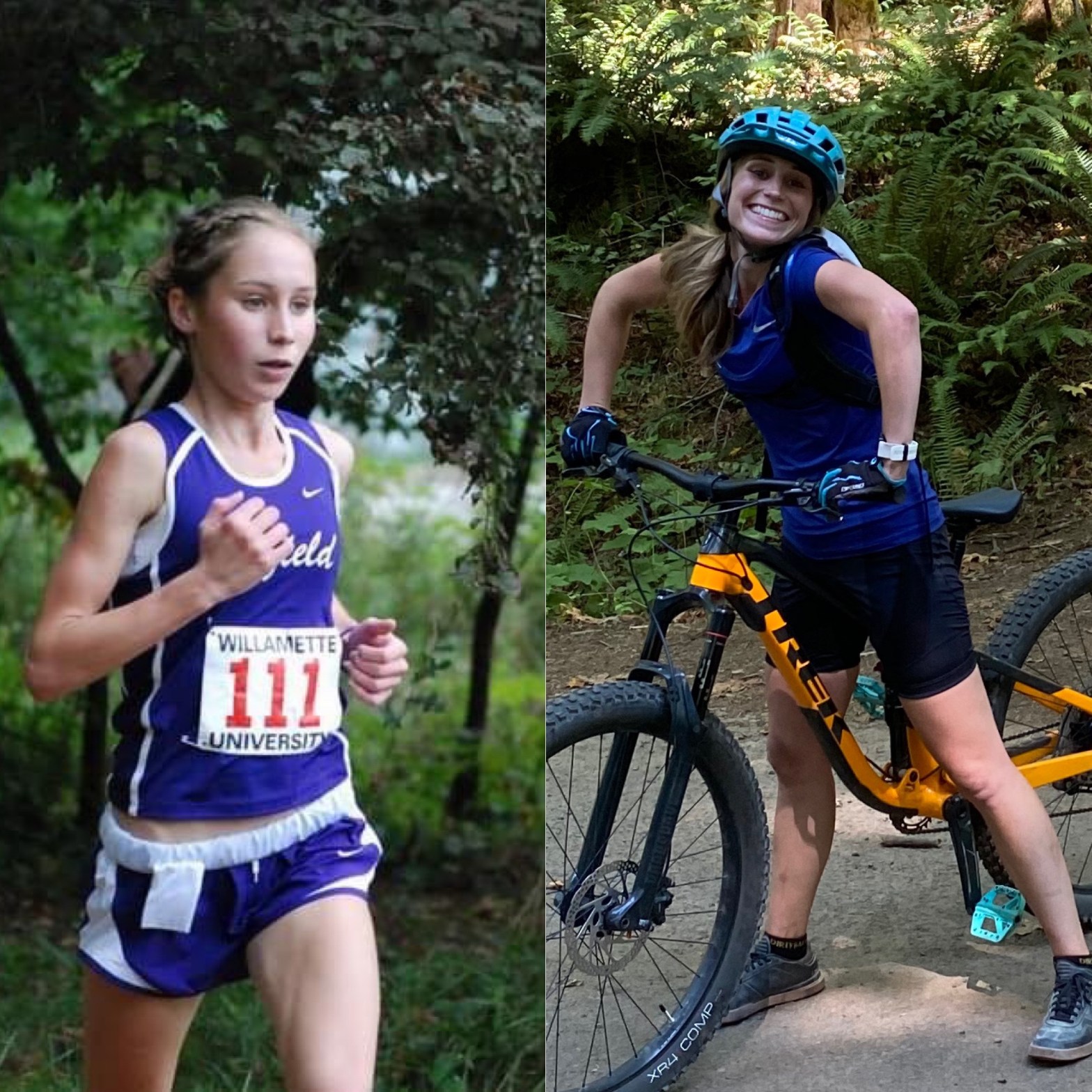
In the last 20 years, much of my attention and energy has gone towards thoughts about, and criticisms of, my body. How it looks; how it feels; how it is performing; what I am putting in it; what I am putting on it. While I am embarrassed to admit this, I don’t think I am unique in this experience. Many females (and males), especially those of the “athlete” mentality, invest a great deal into the wielding of their physique. To a certain extent, this is necessary for performance. If not careful though, it is easy to cross a line and move into the realm of obsession. The sole focus of one’s life can become the shaping and molding of a body. For a decade of my life, I straddled and then crossed this line. From the age of 12 to roughly 22, I saw my body as primarily a tool for sport. My body’s natural intelligence couldn’t be trusted. Instead, it had to be controlled, tamed, and manipulated.
I bought my first diet book in the 8th grade. This was prompted by seeing a particular photo of myself playing soccer. In the photo, I was disgusted at how thick my thighs had become. While muscular, I didn’t see them as sleek…instead they appeared fleshy and excessive in their bulk.
I hadn’t thought too much about food, weight or exercise prior to this. As a young athlete, I rarely had to. My body was fit and strong, but I felt that I could be fitter, stronger. So with that, I stopped the pre-practice Cheezit snack habit and switched to munching on celery with peanut butter, and then, just celery. Instead of happily inhaling whatever dinner was put in front of me, I began making requests – “Less cheese for me, please” or “May I have a smaller portion?”.
Initially, these changes were applauded. They appeared to be gradual and harmless as I was simply becoming more health conscious. After all, by any medical standard, celery is a much healthier snack than Cheez-its. My arms and legs thinned out. My pants size began to shrink.
“Whatever you are doing, it is working. Keep it up!” A coach encouraged me, even going so far as to make comments on the toning of my stature in front of team-mates. While I can now see this for the wildly inappropriate comment that it was, at the time his words led me to swell with pride. I took them as reinforcement that what I was doing was what was expected of me. The world likes small women. Large is offensive; petite is welcomed.
Before I even entered highschool, things began to spiral. My parents, concerned with the amount of weight I’d lost (especially considering how quickly it had been lost), made an appointment for me to meet with an eating disorder specialist. I think they realized they were out of their league when, while out camping one summer weekend, I completely lost it and burst into a fit of tears after a bird swooped in and knocked a partially eaten English muffin out of my hand. I had so many arbitrary rules around food at this point. That was my allotted breakfast, and it was gone. I couldn’t just “eat another”, it didn’t work that way. Everything I consumed needed to fit in a tight and orderly box that I had created in my mind. To eat another muffin felt “unclean” to me. No longer were my habits healthy or balanced, I’d gone off the deep end and was lost in a fight for control. Unfortunately (or perhaps fortunately, in that it led them to seek help) other women in our world had struggled with their relationship to food; this was a pattern my parents were familiar with.
I met with a therapist who suggested I give intuitive eating a try. She encouraged me to “up” my caloric intake and lessen my rigidity around food. I loved the idea of intuitive eating as it allowed for food freedom. I could eat what I wanted, when I wanted. With her help and regular check-ins, I did work to employ this method of eating in my own life. As I mentioned though, I was lost in an internal fight for control. While I wanted to be free of my fixation on food and my body, there was an equally strong part of me that wanted to be thin. I wasn’t convinced that both could be possible. This was a war that continued to rage through all of highschool and a majority of college.
From my freshman through junior year of high-school, my weight – while on the lower end- remained relatively stable and I managed to keep the concern of others at bay. I was running fast and winning most of the local meets. I have learned that if you’re winning, people (and yourself) are hesitant to suggest that something serious, even dangerous, could really be at play. After all, we like a winner.
The summer before my senior year I began to up my mileage, preparing for what I hoped to be the most successful season of my high-school running career. I was putting in roughly 4o miles a week, with a mix of high intensity interval training and longer, endurance focused runs. As the weekly miles began to climb, I simultaneously began to cut back on my food. My main source of fuel was coming in the form of sugar – an apple and a mocha for breakfast, a bagel with cream cheese for lunch and whatever my mother prepared for dinner. Not an ideal diet for an athlete, much less a growing and developing athlete. I wasn’t allowing myself snacks pre or post practice, and I had difficulty breaking from these, now, routine eating habits, as I had determined them “safe”. It was working, I was losing weight. Watching the pounds drop week by week. Warning bells must have been going off for my Mom, as she suggested that I speak to my coach and ask if I had possibly gone a bit too far, losing more weight than healthy.
At the time, I was the fastest girl on our team – a slim, but strong – female high-school runner. While I had lost weight, I wasn’t dangerously thin. Many high-school runners are lean, many female bodies still in the beginning stages of puberty. My coach, a slim runner herself, wasn’t particularly troubled by my size and responded, “Let’s keep an eye on it”.
That season quickly saw me breaking PR’s, clocking 5K’s in the 18 minute range and placing well within the top 10 at some of the larger Oregon meets. There was talk of me winning the district meet – the most competitive event of the season. I started to get calls from colleges who were interested in me competing for them. All the while, my weight continued to drop. I lost 20 lbs that season, on a body that was already considered “thin” by any standard of the word.
Comments of concern started to be made from friends, family and even teachers. One instructor of mine remarked that my collar bone appeared to be frighteningly prominent. And it wasn’t just my looks that were causing concern; my behaviors were raising some red flags as well. I remember going for a smoothie with my best friend and refusing to allot her a sip of my order. Similar to the incident with the bird, I felt that this was my allowed portion of food, and I couldn’t fathom giving any of that away to someone else. To this day, my friend speaks of how crazy such a reaction to the simple sharing of a smoothie had seemed to her. At the time, she also confided in me that her boyfriend was worried about my health. I shrugged off these words of distress. I reasoned that if I was still running well, then I must be fine.
October rolled around and with it came the much anticipated District Cross Country meet. When the gun went off for that race, I surged out with the lead pack and held my own through the first mile, clocking it at around 6 minutes. But as we progressed into the second mile, it was as though I hit a wall. My body just kind of gave out – my brain was sending the signal to run faster, but my muscles weren’t responding to that request. Slowly, more and more girls began to run past me, girls I’d consistently beat throughout the season. Whereas I’d been finishing in the top 10 all fall, I ended the race in the upper third of competitors. It would seem as though my body had finally decided that enough was enough.
Following that race, my cross country coach kept a close eye on me. I knew she was worried for me and my health. While it was upsetting for me to perform so poorly, this event didn’t lead to an instant flip switch in my brain. I didn’t just all of a sudden start to nourish my body properly and make a return to better health. I wanted to get “better”, but I still had a deep fear of gaining weight. I honestly felt like if I gained weight, then I’d be a real failure. It had become a sort of game to me, watching the numbers on the scale go down. Each time the number read lower, it was as though a shot of dopamine was released into my bloodstream. I wanted to prove to others that my weight wasn’t the problem; in my mind, it just couldn’t be.
That winter, I ended up being diagnosed with depressive anxiety. I was put on Lexapro with the hope that medication would help me mentally, but also might have a side effect of some desired weight gain. Often, when someone is deep within the throes of an eating disorder, the weight needs to be addressed prior to the mindset. When someone is significantly underweight, they are rarely thinking rationally and the weight gain must come first.
I did gain some weight, roughly 5 lbs. My family and I saw this progress as indication that I was on my journey towards healing and this gave them faith in my ability to go to college the coming fall. If I was to run in college, I’d need to be able to, at the least, maintain this weight throughout my training.
Once my college season began, I was back to running impressive times and performing well. I quickly became the fastest girl on our team, as a freshman. I was receiving attention and recognition – gracing the cover of our school’s monthly magazine and having upper classmen stop me to ask if I was “that runner girl”. Being an achiever, and very success oriented, I adored the attention that was being directed towards me.
Though I don’t remember why exactly – perhaps for a physical – I ended up in the school’s health department at one point that autumn. Upon checking my pulse (which at the time read 48) the nurse whom I was visiting grew deeply concerned. She was convinced that my low pulse was due to my being severely underweight and she threatened to have me removed from the cross country team until I was able to put on a sufficient amount of weight. She did, however, withdraw this threat when her husband (also a medical professional) assured her that many distance runners have a low pulse. So, once again, I convinced myself – and others – that my weight was not a problem. In a twisted way, I kind of loved that people were worrying. To me, the worry was proof that I was INDEED thin, something enviable. I felt that if people DIDN’T worry, or STOPPED worrying, then that would be a bigger problem. It is pretty messed up, but it is true.
I had an incredible season. My coaches had high hopes for the future of my running career – with talk of breaking school records and competing for national championships. Both my Freshman and Sophomore year I was gifted the Most Outstanding Runner award.
The spring of my sophomore year, injuries began to pop up. I developed what was believed to be a pinched nerve in my achilles tendon. This made running more than a mile extremely painful; it felt like there was something stuck in my shoe, like my achilles was rubbing up against something sharp, but of course it wasn’t the shoes. My body was deteriorating. I was sidelined for the season and spent the majority of my time training in the pool or on the stationary bike.
When cross country started the fall of my Junior year, I worked to rebuild my running base and get my body back to where it was pre-injury. But I soon developed a dull, pin needle sized pain in my pelvis. When running, I’d be fine for about 800 meters and then the throbbing would begin and intensify with duration. After a couple weeks of rest and no improvement, an MRI revealed a stress fracture in my Ischium – the lower, back part of the hip bone.
This stress fracture marked the true beginning of my recovery from what I now see as Anorexia. For the next 6 months, I could not run. Even walking had to be kept to a minimum for at least the first few weeks. It was made clear to me that my low weight, my loss of menstruation, and my high mileage had created the perfect storm for the development of a stress fracture.
During this time, I set off for Ireland to study abroad – something I had applied to and been accepted prior to the development of my injury. This time spent in another country, away from the routines, the foods, access to a scale, and unable to workout in the way that I was accustomed, provided optimal grounds for my initial recovery. Upon my return to the states I resumed therapy and worked to rebuild my relationship with both food and my body. It didn’t happen all at once; it was as they say “two steps forward and one step back” for the better part of a year. Still, there were steps forward.
While I was able to run my senior year, serious damage had been done. My maturing body had taken quite a toll and my times were dramatically slower. I continued to battle injury anytime I sought to increase mileage or pace. No longer did anyone speak to me of National Championships or school records. I no longer could claim the role of our school’s “fastest female distance runner”. This was all a huge blow to my ego and my sense of identity. So much of my self-worth was tied to being a successful runner. I wasn’t quite sure who I was without it. I was also deeply embarrassed. To no longer be clocking the times I once was and having been unable to maintain a low weight, I felt like a failure and was sure that others also must see me as such.
No longer having the sport of running upon which to gain a sense of value or purpose, I was forced to address the deep feelings of insecurity, as well as the desire for control, that had encouraged the development of an eating disorder in the first place. With more time and energy to give to other areas of my life, the eating disorder’s hold upon me began to unravel. I was better able to challenge the voice in my head, to practice some flexibility as opposed to rigidity. Not to say this recovery was fast or easy. It took years of therapy. In fact, I am STILL in therapy and often my therapy sessions consist of me readdressing old thought patterns with food, my body and exercise. I did emerge from the hole I’d slowly descended into though, and I have managed to keep from falling back into those dark depths.
While I know it isn’t helpful, I do have regrets. I wish I could go back and tell that 12 year old me to put the diet book back on the shelf. She doesn’t need that. I want to encourage her to trust her body and to let it develop naturally, in it’s own way. I want to hug her and remind her that there’s so much more to this life than being thin or fast. I want to tell her that people love her because of her spirit, not because of what she can do in a pair of running shoes. The main goal in her life needn’t be to shrink and contract. And maybe, if I could go back and do this, I’d be able to save her from years of hurt, of lost moments and of obsession. It is even quite possible she’d have seen longer lasting success as a runner. Her body, following its own wisdom, would likely have laid the perfect foundation upon which to develop the muscle and stamina needed for the intensity of competitive distance running.
But, I can’t go back. And while I am not sure everything happens for a reason, there is certainly a lesson to be gleaned from everything that happens. My body isn’t just a tool to be manipulated. My worth doesn’t lie in my success. All of the therapy, the journaling and the self help books have helped me to strengthen my body image, though I still struggle and continue to work on this. Ultimately, I do have a better understanding of my own physical limits and I have learned to be gentler on myself.
That was a chapter in the story of my relationship to my body. There is no tidy bow upon which to wrap this chapter up, as I still struggle with my attitude towards exercise, my thoughts around what to eat and how much…the main difference is that now, these thoughts are less frequent, and I am better able to confront them before they consume me. In the last six years, a lot has transpired for me in the area of health. I received a cancer diagnosis that completely rocked my world and reshaped, yet again, my experience within this physical body. I doubt I will ever say that I am completely free of disordered eating, or that “I love and accept my body exactly as it is, each and every day” … though I do aspire to this. For now, simply putting these words on to the paper is helping me give voice to a reality that is far too common, especially amongst female athletes. My hope is that through sharing my story I can help keep others from wandering down the same path that took me so far from myself.
 backtomeblog.com